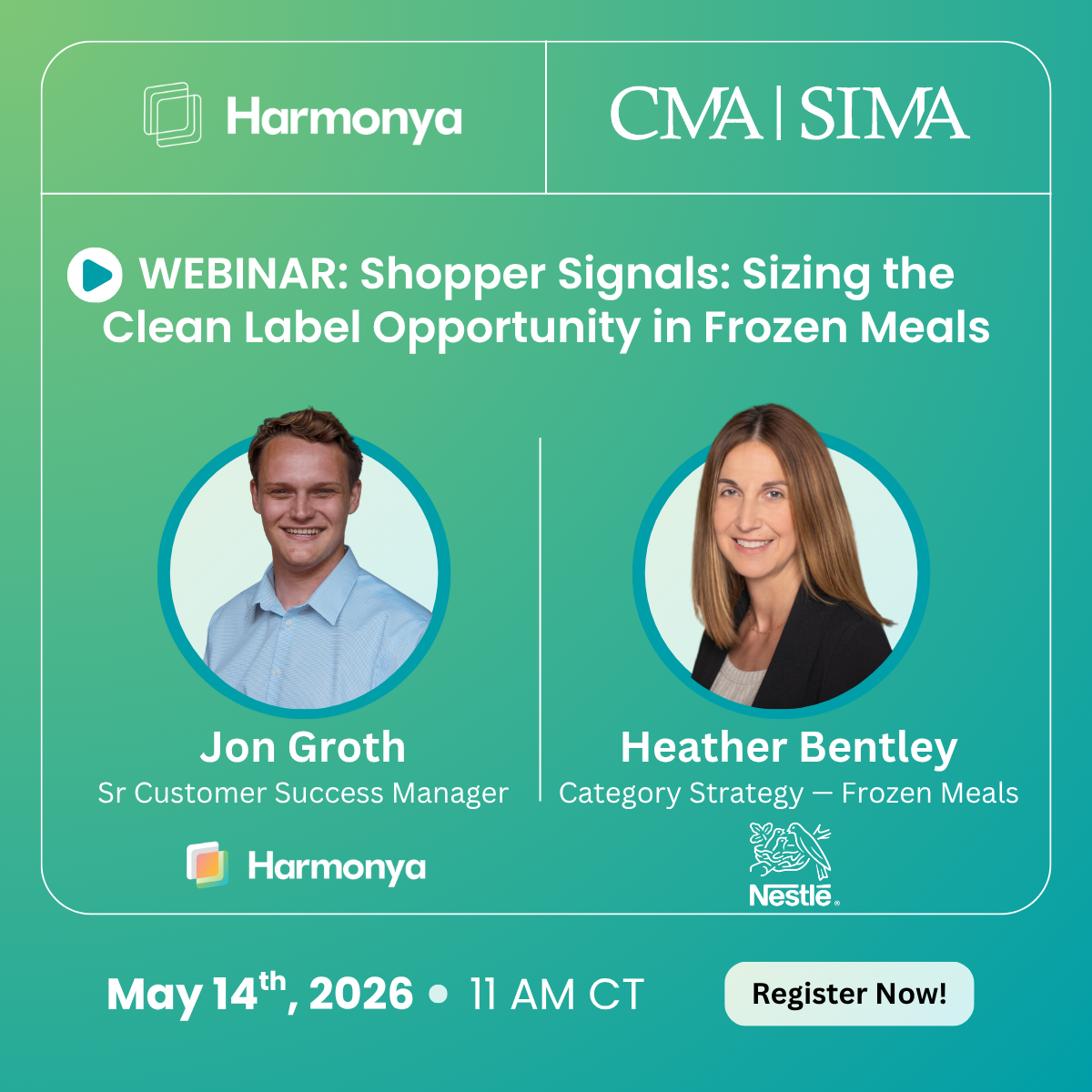
Harmonya and Nestle walked through how a review-driven analysis of 115,000+ frozen meal reviews surfaced four distinct Demand Themes inside "clean label," then sized each against UPC-level sales to reveal where brand investment and shopper attention diverge.
"Clean label" gets used constantly in frozen meals, but what it actually means depends on which shopper you ask. Some describe it through the lens of nutritional transparency. Others focus on ingredient simplicity, sourcing ethics, or how a product fits a specific diet or lifestyle. For category teams building assortment and merchandising strategies around health, that ambiguity makes it hard to know where to invest.
In this CMA webinar, Heather Bentley (Category Strategy, Frozen Meals at Nestlé) and Jon Groth (Senior CSM, Harmonya) walked through how a review-driven analysis translated more than 115,000 shopper conversations into four distinct Demand Themes, then quantified each one against UPC-level sales data.
If you missed it live, here's what we covered:
The session opened with a framing that set the tone for everything that followed: how "health" in frozen meals has fundamentally changed.
The old model was subtractive. Less fat. Fewer calories. Lower sodium. Products earned their health halo by what they removed. The modern version of clean label is additive. More protein. More fiber. Functional ingredients like prebiotics and immune support. And it extends well beyond nutrition into sourcing transparency, ethical production, and how a product is made.
Heather's team had already sensed this shift directionally, but they couldn't define it precisely or size the commercial implications. They knew health meant more than "low calorie," but they didn't have a structured framework that mapped shopper language to real demand signals.
Harmonya's methodology followed three steps:
First, the team analyzed how consumers describe "clean label" across 115,000+ frozen meal reviews, using consumer language rather than predefined claims. These signals were grouped into standardized Demand Themes that reflect both functional and lifestyle dimensions of clean label.
Second, individual claim signals and language variants were mapped to UPCs. Tags like "protein," "fiber," and "immune support" were mapped into a Demand Theme based on shared intent, capturing both manufacturer-led claims and consumer-described benefits.
Third, each Demand Theme was sized by sales volume, year-over-year growth, and brand share. The analysis yielded eight or more initial themes. Heather's team then narrowed to the four that mattered most based on UPC coverage, sales weight, and where brand investment and consumer attention diverged.
The four themes the analysis surfaced:
Two of these four themes — Responsible Sourcing and Diet & Lifestyle — had little overlap with what brands were emphasizing on their product pages. That gap set up the most important part of the session.
Before showing the disconnect, the session introduced a concept that made the data easier to interpret: the difference between brand-led and consumer-led Demand Themes.
When these two signals align, a brand is investing where shoppers care. When they diverge, there's either an untapped opportunity or wasted investment.
The data showed that brands in frozen meals are heavily concentrated in Ingredient Integrity and Nutrition & Functional Benefits. These themes dominate PDP claims. But consumer reviews tell a different story. Shoppers allocate significant attention to Responsible Sourcing and Diet & Lifestyle — themes where most brands have minimal presence on the product page.
The gap in Responsible Sourcing was the most striking. The majority of brand investment in clean label messaging focuses on ingredients and nutrition, while shoppers are increasingly talking about how products are sourced, whether packaging is sustainable, and whether production practices align with their values.
This isn't a case of brands investing in the wrong themes. Nutrition and ingredients still matter. The issue is that the investment is concentrated, and the themes that are growing fastest are the ones getting the least attention from manufacturers.
The session closed with what the analysis led to inside the Nestlé frozen meals team:
The core takeaway: "clean label" is not one thing. It is four distinct demand dimensions, each with a different commercial footprint. The gap between where brands invest and where shoppers focus is wider than most category teams realize.
The framework is repeatable across categories. Map what brands claim against what consumers say. Size each theme against real sales. Use the gap to prioritize where to invest next.
Teams that connect product data, consumer feedback, and market signals see what's shaping demand faster and with more confidence. Let's talk about how Harmonya turns fragmented data into decision-ready intelligence.
Thirty minutes on your categories. How the attributes get built, and the questions your team could put to them.